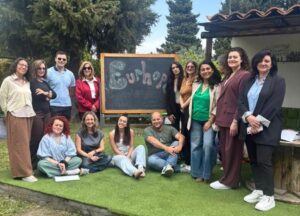



The protection of the rights of minors, particularly the most vulnerable and those living outside their family of origin, represents one of the primary objectives of the European Union today. Indeed, the EU is strongly committed to reducing poverty and social exclusion rates, as reaffirmed during the 2021 Porto Social Summit. In this delicate landscape, the training program of the EURHOPE project highlights how the preparation of “supportive positive adults” is a fundamental component in providing concrete support to those adolescents with social difficulties living in residential care communities.
The European Context: The Need for Informal Relationships
At the international level, institutions have long been pushing for more integrated forms of care. As early as 2009, the United Nations General Assembly approved the Guidelines for the Alternative Care of Children. These guidelines establish that, when it is not possible for a minor to grow up within their own family, alternative forms of care (foster care and residential care) must provide a highly protected and supportive environment. In parallel, the European Union promotes deinstitutionalization, encouraging family- and community-based forms of care.
In Europe, the emergency is tangible and is reflected in the significant numbers of boys and girls between the ages of 11 and 17 hosted in residential communities, who represent the majority of minors currently living “outside the family.” Added to this number is a significant portion of the thousands of Unaccompanied Minors, mostly sixteen or seventeen years old, who arrive in our countries living in a profound state of loneliness.
Although all these young people receive formal and professional responses (education, schooling, healthcare) from the socio-educational staff of the communities, only a minimal fraction of them benefit from informal and lasting relational networks with adults. The absence of affective bonds exposes these youth to forms of social marginalization and relational poverty that severely impact their bio-psycho-social well-being.
Significant Relationships and Mentoring: A Driver of Growth
The availability of a nurturing environment and warm relationships has a formidable impact on the growth of adolescents. Recent studies emphasize how warm and nurturing relationships promote prosocial behavior and act as a protective barrier against mental health problems during the developmental phase. In this context, relational support and mentoring prove to be valuable strategies from a perspective of preventing distress.
Mentors, or “positive adults,” offer role models, support, and guidance, decisively influencing psychosocial development. Through significant relationships, young people learn to manage conflict, improve communication, and develop empathy. Furthermore, a reference adult acts as a true “promoter of independence,” facilitating better access to education and employment while simultaneously reducing the involvement of youth in risky behaviors.
Training to Support: The Key Role of Preparation
Supporting young people with complex backgrounds cannot be improvised. It therefore becomes essential to structure a training path for positive adults, with clear objectives ranging from the emotional-relational sphere to the practical-operational and social-educational ones. Volunteer adults must be able to build bonds based on trust, manage their own emotions and those of the minor, and support the latter on the journey toward autonomy.
Investing in positive adults means transforming local communities into safety nets and networks of opportunity, ensuring that the European promise to leave no one behind becomes, day after day, a tangible and splendid reality.